
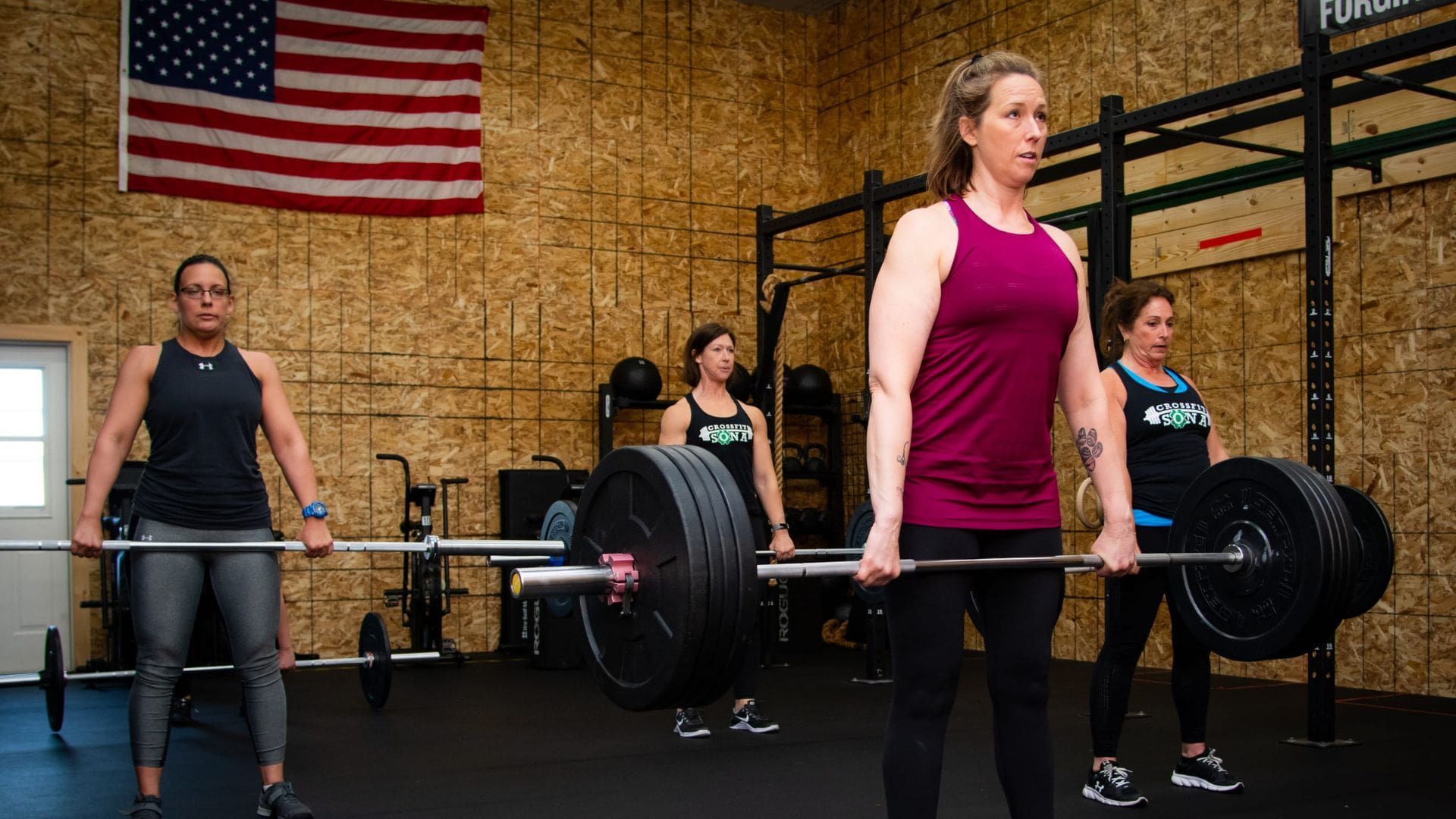
Most people who walk into a CrossFit gym for the first time assume it is built for a certain kind of person. Someone younger, more athletic, with more time and fewer obligations. What they find, more often than not, is a room full of working adults, parents, people in their 40s and 50s, who came in with the same assumption and stayed because the training turned out to be exactly what their actual life needed.
This article is about what that training is really for. Not performance. Not aesthetics. Capability, over time, in the ordinary moments that nobody photographs.
What “Functional Strength” Actually Means (Without the Jargon)
Functional strength is easier to understand through a regular Tuesday than through a definition.
It is lifting a full laundry basket off the floor without bracing yourself for it. Carrying groceries in from the car in one trip without thinking twice. Getting up from the floor without needing something to grab onto. These are things you do without noticing, until the day you cannot.
The test is not how you perform in the gym. The test is whether you threw your back out reaching for something on a low shelf, and functional strength is what makes that a non-event instead of a week of recovery. The number on a barbell is not the point. Whether your body can handle what your actual life asks of it, on a random Wednesday when nobody is watching, that is the point.
As a coach, functional strength means training people for the life they are actually living. Not for a competition, not for aesthetics, but for the ability to show up physically capable in every ordinary moment for as long as possible. It is about building a body that works for you across decades. And it has nothing to do with how much you can lift in ideal conditions, how you look, or whether you have ever touched a barbell. It starts the moment you decide your body deserves to be capable.
The Difference Between Looking Strong and Being Strong
There is a version of fit that lives entirely in the mirror. Someone who has put in real time on isolated movements, looks athletic by any measure, but gets winded carrying luggage through an airport or has to think carefully about how to get up off the ground at a picnic.
The aesthetic got built without the foundation. Strength in the muscles that photograph well, but gaps in the movement patterns that actual life requires. That is not a character flaw. It is just what happens when the goal is appearance and the training follows the goal. You get exactly what you trained for, and nothing you did not.
When most people say they want to get strong, what they usually mean is that they want to feel different than they feel right now. More confident, more capable, less embarrassed by their own body, more in control of something. That is not wrong. It is just incomplete. How you look is a byproduct of how you train and live, not a destination you arrive at and stay. The miss is treating the body like a project to finish rather than a system to maintain for the rest of your life.
What CrossFit Is Actually Preparing Your Body to Do
The scenarios are not glamorous, which is exactly the point.
Lifting a car seat, a toddler, or a dog into an SUV without tweaking your lower back. Repeatedly, on no sleep, in a parking lot. Moving furniture, carrying boxes up stairs, or helping someone load a truck on a Saturday morning without being wrecked for the rest of the weekend. Sitting at a desk for eight hours and still having enough body left at the end of the day to get on the floor with your kids or take a walk without everything aching.
And then there is the one nobody talks about until they need it: catching yourself when you slip. The reflexive, split-second ability to not fall, or to fall well. That is one of the most important physical skills a person can have, and it only exists if you have trained for it.
Take the deadlift as an example. The deadlift is picking something up off the floor with a neutral spine and your legs doing the work. Which is exactly what you are doing when you lift a 40-pound bag of dog food, a laundry basket from the bottom of the stairs, or a sleeping kid out of a car seat at 11pm. Most people who hurt their back in daily life did not do something dramatic. They bent over wrong, in a hurry, when they were tired, and their body had no pattern to default to. The deadlift is that pattern. The training is not about pulling heavy weight in a gym. It is about giving your body something to fall back on when the moment comes and you are not thinking about it.
Why Capability Matters More Than Performance for Most People
Capability means your body can meet your life where it is. Not on a good day when you are rested and ready, but on a random Thursday when you are tired and it asks something of you anyway.
Performance numbers have their place, but they measure you in ideal conditions. Capability is what shows up in the parking lot, the stairwell, the moment you did not see coming. That is the part that actually affects your quality of life. Most of the people we coach are not training for a competition. They are training for another decade. For that goal, “I can do hard things without breaking” matters more than what is on a whiteboard.
There is a member who came in originally focused on weight loss, tracked everything, measured progress the way most people do. Then one day they mentioned almost as an aside that they had helped a friend move over the weekend and just did not feel it afterward. Not sore, not wrecked. They did it and went on with their day. And it stopped them, because they remembered what that used to cost them.
They did not hit a PR that week. Nothing notable happened in the gym. But that was the moment it clicked that something had actually changed, quietly, without them noticing. Which is exactly how real progress works.
The Kinds of Adults Who Get the Most Out of This Training
The person in the middle of a full life. Working, parenting, managing something, responsible for other people, who has quietly put themselves last for long enough that they have started to feel it, and is ready to stop negotiating with themselves about it.
People in their 40s and 50s who have started noticing that recovery takes longer, that their body feels different than it used to, and who want to get ahead of what is coming rather than react to it later. And anyone who does not trust themselves to do it alone. Not because they lack discipline, but because they know they need a coach, a set time, a room full of people expecting them, and a plan that is already made.
The worries people bring in before starting are usually the same ones. That they are too far behind, too out of shape, too old, or too busy to actually be consistent. The structure exists precisely because those things are real, not because we are ignoring them. That they will be the least fit person in the room and everyone will notice. What actually happens is they walk in and find people who look exactly like them, at every stage, just further down the same road.
The most common thing we hear after the first few weeks is some version of “I don’t know why I waited so long.” That is worth sitting with, because the cost of waiting is real even when it is invisible.
The person who surprises themselves is almost always someone who came in certain they would be the exception. Too busy, too stiff, too far gone. They showed up anyway, probably reluctantly, and discovered that the structure did what they could not do for themselves. The shift tends to be quiet rather than dramatic. They stop making the decision every week about whether to come. It just becomes where they go. And the surprise is rarely “I am stronger than I thought.” It is more often “I am more capable of doing hard things consistently than I gave myself credit for,” and that realization tends to reach well past the gym.
Why Consistency Over Years Beats Intensity Over Weeks
A short program can build fitness. Consistency over a year or two builds a body that knows what to do under fatigue.
Not just when you are fresh and motivated, but when you are tired and stressed and doing it anyway. That is when the adaptation that actually lasts gets made. Movement patterns become automatic. The hinge, the brace, the catch. So that when your back is at risk in a parking lot at 7pm on a Tuesday, your body protects you without you thinking about it. That only happens after hundreds of repetitions across months, not weeks.
The person who has trained consistently for two years does not just have a stronger body. They have a different relationship with hard things, with showing up when they do not feel like it, with trusting the process when there is nothing dramatic to show for it yet. No six-week program manufactures that.
When something faster is tempting, the honest conversation is not about whether it will work. Some of it probably will, for a while. The question is: where did the last one leave you? And the one before that? Because something always comes after the program ends. If there is no structure, no community, no coach on the other side, most people quietly unwind what they built.
A year from now you are going to be somewhere. The only thing that determines whether you are further along or starting over is whether what you are doing is something you can actually sustain.
Strong Enough for What: Defining Your Own Standard
Figuring out what strong enough means starts with questions that have nothing to do with the gym. What do you want to be able to do at 65 that you are worried you will not be able to do? What does a physical limitation currently cost you in your daily life? What would you do more of if your body was not the thing holding you back?
Strong enough is different for everyone, and it is almost never about a number. For one person it is keeping up with their grandkids on the floor. For another it is hiking without dreading the descent. For another it is just not hurting at the end of a workday. Once you know what strong enough looks like in someone’s actual life, the training has a real target. And a real target is what separates people who stay from people who drift away when motivation dips.
The question worth asking yourself: what do you want your body to still be able to do in twenty years, and are you doing anything right now that makes that more or less likely?
Most people set fitness goals based on how they want to look in the next ninety days. That is fine, but it is a short horizon for a decision with twenty or thirty year implications. That one question moves the conversation from aesthetics and urgency to something more durable. The members who are thinking about it that way are almost always the ones who are still here two years later.
If that question resonates, we are worth a conversation. Come see what the training actually looks like, ask what it would mean for your specific life, and decide from there.


